
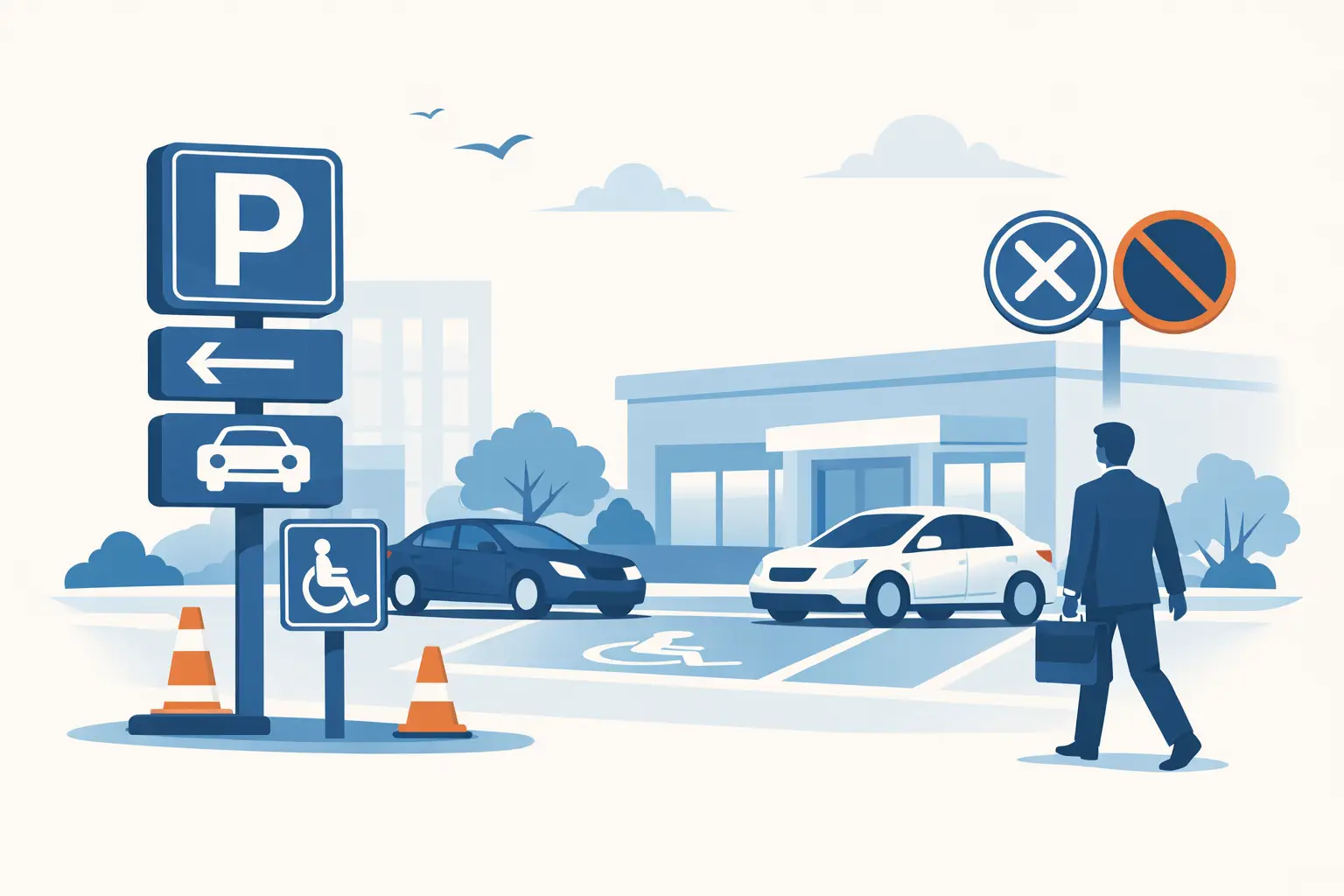
A customer pulling into your lot should know exactly where to go within seconds. If they hesitate, park in the wrong spot, block a service bay, or miss your customer entrance, that is not a traffic problem. It is a signage problem. Parking signs for businesses do more than label spaces. They direct flow, protect access, support safety, and make your operation look organized from the curb.
For automotive businesses especially, parking lot confusion can create daily friction. A repair shop may need separate areas for customer parking, overnight drop-off, staff parking, tire storage pickups, tow-in vehicles, and service lane check-in. A dealership may need reserved inventory zones, customer pickup areas, and accessible parking that stays visible in all weather. Good signs reduce guesswork. Better signs reduce interruptions.
Why parking signs matter more than most businesses think
A parking lot is one of the first operational touchpoints your customers experience. Before they speak to your staff, they are already reading your business through the condition of your exterior, the layout of the lot, and the clarity of your signs.
When signage is missing or inconsistent, staff end up solving avoidable problems all day. They answer the same parking questions, move vehicles that should not be there, and deal with blocked doors or bays. That costs time. In a busy shop, even small delays stack up.
Clear parking signs for businesses also help with liability and compliance. Accessible spaces, fire lanes, loading zones, and no parking areas should not be left open to interpretation. In some cases, the exact wording, placement, or visibility matters. If your lot serves both customers and working vehicles, signs are part of keeping the site functional and defensible.
What good parking signs for businesses actually do
The best parking signs are not complicated. They do one job clearly and hold up under real conditions. That means they are easy to read from the right distance, use direct wording, and are built from materials that can handle sun, rain, snow, and regular exposure.
Good signs usually solve one of four business needs. They reserve space, restrict access, direct traffic, or communicate rules. A “Customer Parking Only” sign handles one need. A “Service Check-In” sign handles another. A “No Parking – Keep Bay Door Clear” sign prevents a specific operational problem.
That sounds simple, but many businesses try to make one sign do too much. A cluttered sign with too many lines, small text, or weak contrast gets ignored. If the message needs to be understood from a moving vehicle, simplicity wins.
Start with your real parking problems
Before ordering signs, look at where confusion happens now. Not where you think it happens – where your team sees it every week.
If customers routinely park in staff spaces, you need clear reserved parking signs. If delivery trucks block a service entrance, you may need larger no parking or loading zone signs. If after-hours drop-off is part of your business, customers need clear direction at the point they enter the lot, not just at the front door.
For trade businesses, this often comes down to workflow. A sign is not just there to mark property. It should support how work moves through your site. That is especially true for automotive service businesses where vehicles are constantly arriving, being staged, serviced, and picked up.
A few practical examples include customer parking, employee parking, vehicle pickup, tow-in drop-off, service lane entrance, accessible parking, visitor parking, and fire route signage. The right mix depends on your property size, traffic volume, and whether you need permanent signs, seasonal updates, or custom instructions.
Stock signs vs. custom signs
There is a place for both. Stock parking signs work well when the message is standard and widely understood. If you need a basic “Reserved Parking,” “No Parking,” or accessible parking sign, a ready-made option can do the job efficiently.
Custom signs make more sense when your lot has specific operational needs or when branding matters. A sign that says “Customer Parking for Service Reception” is more useful than a generic parking sign if your site layout is not obvious. The same goes for signs marking tire hotel pickup, express lube parking, dealer pickup, or staff-only staging zones.
Custom parking signs for businesses also let you match the look of your site. That does not mean decorative design. It means using your logo, brand colors, and consistent formatting so the lot feels managed, not patched together. For dealerships, garages, and professional service businesses, that consistency adds credibility.
Material and durability are not small details
If a sign fades fast, bends easily, or becomes hard to read after one season, it stops being a good value. Parking signs are outdoor operational tools. They need to stay readable and hold their shape.
Material choice depends on where and how the sign will be used. Aluminum is a strong choice for permanent exterior parking signs because it resists rust and handles weather well. Coroplast can work for short-term or lighter-duty use, but it is not ideal where signs need long-term strength. Reflective finishes can help in low light or overnight conditions, especially for businesses that offer early drop-off or late pickup.
Print quality matters too. Sharp text, strong contrast, and weather-resistant inks help signs perform longer. This is one of those areas where cheaper is not always cheaper. Replacing poor signs every season is usually more expensive than ordering durable ones once.
Size, placement, and readability
A well-made sign can still fail if it is too small or placed in the wrong spot. Parking signs should be readable before the driver reaches the decision point. If the sign is only visible after a customer has already turned into the wrong lane or parked in the wrong area, it is late.
Think about the driver’s view. Is the sign visible from the lot entrance? Can it be blocked by parked trucks, snowbanks, or landscaping? Is the text large enough for someone reading it from a vehicle, not standing two feet away?
Contrast is another factor people underestimate. Dark text on a light background or the reverse usually performs better than low-contrast combinations. Fancy fonts do not help. Direct wording, clean type, and enough spacing do.
Common mistakes businesses make with parking signs
The first mistake is under-signing. Many businesses assume the layout is obvious because staff see it every day. Customers do not. What feels self-explanatory to your team may be unclear to a first-time visitor.
The second mistake is inconsistency. Mixed sign styles, different wording for similar spaces, and faded older signs create doubt. When signs look temporary or improvised, people trust them less.
The third mistake is treating signage as separate from operations. Your parking signs should reflect how the business actually works. If your shop has changed its service flow, expanded staff parking, or added after-hours key drop, your signs should change too.
Finally, some businesses try to save space by putting too much information on one sign. Parking signage works best when each message is clear and fast to process. Drivers should not need to stop and study it.
How to choose the right supplier
A dependable sign supplier should understand more than print specs. They should understand use case. A business buying parking signs is usually solving a day-to-day problem, not shopping for decoration.
That means you want clear product options, durable materials, customization where needed, and production times that fit business reality. If you need repeat orders across multiple locations or want signs that match your other operational print materials, consistency matters. StickerPlanet Canada serves businesses that need that practical mix of speed, quality, and repeatable results.
For automotive shops, service centers, and dealerships, working with a supplier that understands operational signage can save time upfront. You are less likely to end up with the wrong size, weak material, or generic wording that does not fit how your lot runs.
A good sign pays for itself in fewer interruptions
Parking signs are easy to overlook because they are simple by design. But the effect is measurable. Fewer misplaced vehicles, fewer customer questions, cleaner traffic flow, and a more professional first impression all come from getting the basics right.
If your lot creates confusion, your signage is part of the fix. Start with the problem areas, choose signs built for outdoor use, and keep the message direct. A customer should know where to park without asking, and your staff should not have to manage preventable parking issues all day.