
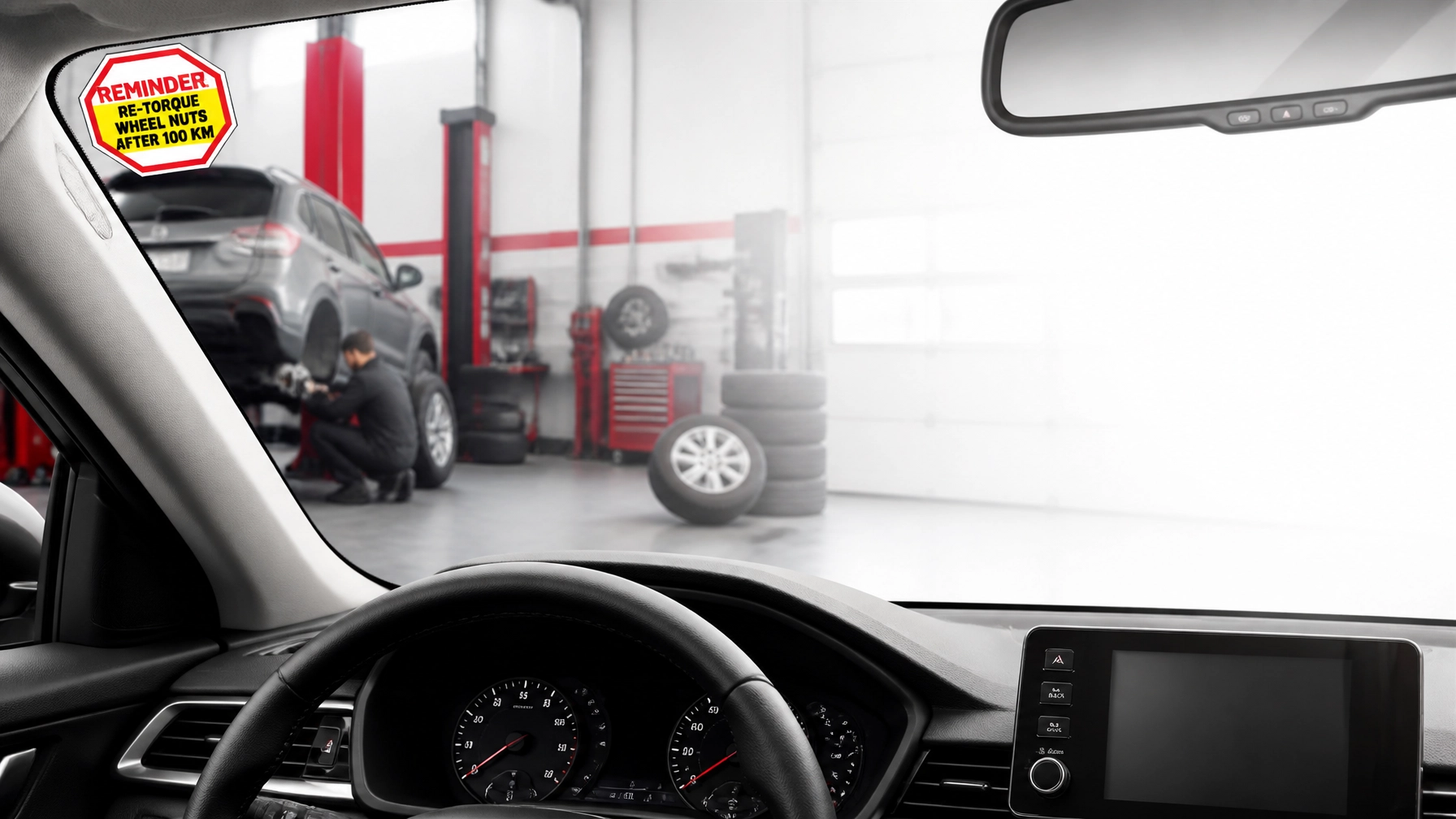
Seasonal tire changes create a predictable service requirement: customers need to return for a wheel-nut re-torque after driving a specified distance. A generic tire re-torque sticker gives your team a simple way to communicate that instruction before the vehicle leaves the shop.
The sticker is not a replacement for correct installation, torque procedures, or customer communication. It is a visible reminder that supports those procedures.
For Canadian tire shops, the most effective process is straightforward:
- Complete the seasonal wheel service correctly.
- Record the service date and the vehicle’s odometer reading in kilometres.
- Apply a small reminder sticker to the correct windshield location.
- Confirm that the customer understands when to return.
- Use a consistent final check before releasing the vehicle.
Canadian tire guidance commonly recommends a follow-up check after approximately 50–100 km, depending on the shop’s procedure, the vehicle manufacturer’s requirements, and the wheel service completed. Continental’s Canadian guidance recommends checking wheel fasteners after the first 50 kilometres, while CAA guidance recommends completing the check within 100 kilometres. Always follow your shop’s approved procedure and the vehicle manufacturer’s torque specifications.
Why use a generic re-torque sticker during wheel swaps?
A generic sticker is useful when you need a professional reminder without ordering a custom design for every location, dealership, or service department.
It can help your shop:
- Standardize customer instructions across busy seasonal appointments.
- Keep the re-torque requirement visible after the customer leaves.
- Reduce reliance on handwritten notes or verbal reminders alone.
- Give service advisors a consistent handoff tool.
- Reinforce your shop’s safety-focused process.
- Support a professional customer experience without adding unnecessary paperwork.
- Keep the reminder visible until the required follow-up is complete.
A generic sticker is especially practical for high-volume winter and summer changeover periods. Your team can keep the same stock on hand and apply it to every qualifying vehicle.

Five-step workflow for Canadian tire shops
The following workflow is designed for service managers, tire technicians, and front-counter teams. It can be adapted to your existing work order and quality-control process.
1. Complete the seasonal wheel service
Begin with the wheel service itself. The sticker should be applied only after the technician has completed the installation and initial torque procedure.
The final service should include:
- Correct wheel and tire installation for the vehicle.
- Clean, properly seated wheel-to-hub mating surfaces.
- Correct wheel hardware for the application.
- Lug nuts or wheel bolts tightened to the vehicle manufacturer’s specification.
- A calibrated torque wrench used for the final torque.
- The correct tightening sequence, such as a star or cross pattern where applicable.
- A completed technician inspection according to your shop’s procedure.
Do not treat the sticker as proof that the wheels were torqued correctly. It is a follow-up reminder for the customer and a process-control tool for your business.
If the technician finds damaged studs, unsuitable hardware, corrosion, contamination, or another issue that affects wheel installation, resolve that issue before moving to the reminder stage.
2. Record the service date and KM information
Record the information while the vehicle is still on the work order. Do not wait until the customer is standing at the counter.
At a minimum, document:
- Service date
- Odometer reading at installation
- Recommended re-torque interval in KM
- Target re-torque odometer reading, where your system uses one
- Technician initials or work-order identification
- Any customer-specific instructions
For example, if the vehicle shows 123,450 km at installation and your shop uses a 100 km interval, the customer should return at approximately 123,550 km.
The sticker itself does not need to carry every work-order detail. Your shop management system or printed invoice should retain the complete service record. The sticker should communicate the action clearly and quickly.
Use KM or kilometres consistently. Avoid mixing kilometres and miles on Canadian customer materials, especially during a busy seasonal changeover.
3. Apply the reminder correctly
Apply the approximately 2 x 2 inch sticker to the inside face of the windshield, positioned in the top-left corner from the driver’s perspective inside the Canadian left-hand-drive cabin.
Correct application matters. The sticker should be:
- Applied to clean, dry glass.
- Flat against the inside surface.
- Readable from the driver’s seat.
- Positioned where it does not obstruct the driver’s view.
- Kept away from the steering wheel, dashboard, trim, and instrument cluster.
- Easy for the customer to see before leaving the shop.
Do not place the sticker on the outside of the windshield. Do not attach it to the steering wheel. The inside top-left windshield position makes the reminder visible while keeping it separate from vehicle controls.
Before applying the sticker, remove dust, moisture, cleaning residue, and other contaminants from the selected glass area. Press the sticker down evenly, especially around the edges.
Durable vinyl is well suited to this application because it helps the reminder remain clean and legible during normal vehicle use. StickerPlanet.ca uses eco-solvent inks for all stickers, supporting clear, durable printed graphics for automotive service applications.
4. Verify the customer handoff
A sticker is most effective when the service advisor explains it directly. Use a short, repeatable script rather than relying on the customer to read the label without context.
For example:
“Your seasonal wheels have been installed and torqued to the manufacturer’s specification. Please return after approximately 100 km, or according to the interval shown on your paperwork, for the follow-up wheel re-torque. The reminder sticker is inside the top-left corner of your windshield.”
If your shop provides the follow-up check at no charge, state that clearly:
“The follow-up re-torque is provided at no cost by our shop. Please come back within the recommended distance.”
The service advisor should confirm that the customer knows:
- Why the follow-up is required.
- The approximate KM interval.
- Whether the shop requires the vehicle back within a specific number of days.
- Where the reminder sticker is located.
- What to do if the customer notices vibration, pulling, clunking, or unusual noise before the follow-up.
A visible sticker and a verbal explanation work better together than either method on its own.

5. Standardize the final check
Before the vehicle leaves the property, use a final checklist. This should be a standard part of the seasonal wheel-swap workflow, not an optional step that depends on the individual technician.
A useful final check includes:
- Wheel installation completed.
- Torque procedure completed to the correct specification.
- Service date recorded.
- Odometer reading recorded in KM.
- Re-torque interval identified.
- Generic sticker applied to the inside top-left windshield area.
- Sticker readable from the driver’s position.
- Customer instruction provided.
- Work order updated.
- Follow-up requirement marked complete or pending.
A simple digital checkbox or printed inspection line is enough. The objective is consistency.

What should a generic sticker say?
A generic sticker should use direct wording that applies to a wide range of vehicles and seasonal services.
A practical Canadian version may include:
- REMINDER
- RE-TORQUE WHEEL NUTS AFTER 100 KM
- Service date: ______
- KM at installation: ______
- Return KM: ______
The final wording should match your shop’s established procedure. If your policy uses 50 km, 70 km, or another interval, the sticker and customer explanation should agree with that policy.
Avoid overcrowding the label. The customer should understand the primary action in a few seconds. Technical details such as torque specifications, wheel hardware, and work-order notes should remain in the service documentation unless your shop has a specific reason to print them on the sticker.
Generic or custom: which option is right?
Generic stickers are a practical choice when:
- You need stock immediately.
- Several locations share the same process.
- You want one standard reminder for seasonal work.
- You do not need the shop name or phone number printed on the label.
- You want to reduce design and approval time.
Custom tire re-torque stickers are more appropriate when you want:
- Your shop name and contact details.
- A branded customer experience.
- A location-specific return instruction.
- A custom layout, shape, or message.
- Additional space for service information.
StickerPlanet.ca manufactures both generic and custom tire re-torque reminder stickers in Canada. The company uses premium North American materials, durable vinyl options, and eco-solvent inks for all stickers.
Why order from StickerPlanet.ca?
For a seasonal program, supply reliability matters as much as the printed design. StickerPlanet.ca offers:
- Canadian manufacturing rather than overseas resale products.
- Premium materials made in North America.
- Professional printing experience.
- Fast shipment of approved stock and custom items, generally within two business days.
- Courier shipping with tracking and insurance.
- No setup fees, rush charges, or hidden costs.
- Straightforward options for generic and custom automotive reminder stickers.
You can review StickerPlanet.ca’s sticker materials or visit the FAQ page for ordering and production information. For custom requirements, use the contact page to discuss your application.
Make the reminder part of the process
Generic tire re-torque stickers work best when they are built into the service workflow. Apply them after the technician completes the wheel installation, record the date and KM information, explain the reminder at handoff, and confirm the final checklist before releasing the vehicle.
The process is simple. The benefit is consistent.
Order generic or custom automotive stickers from StickerPlanet.ca and give your team a clear, professional reminder system for every seasonal wheel swap.