
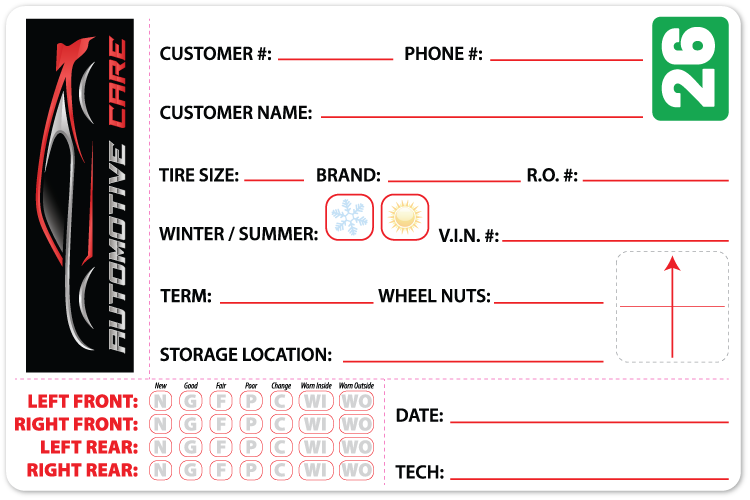
Seasonal tire storage becomes difficult when a shop relies on memory, handwritten notes, or unmarked tire piles. A clear, durable label gives every tire set an identity before it enters the storage area.
Custom tire storage stickers from StickerPlanet.ca help automotive shops record the information technicians need during storage, retrieval, and seasonal installation. The right layout can reduce customer mix-ups, shorten search time, and create a more consistent workflow across the entire shop.
For most Canadian automotive businesses, the best label includes seven practical fields:
- Customer ID or name
- Tire size
- Season
- Wheel position
- Storage location
- Service or date reference
- Shop contact details or technician initials
The label size should match the amount of information and the surface where it will be applied.
Why the seven fields matter
A tire-storage label should answer two questions quickly:
- Who does this set belong to?
- Where does it go next?
The seven fields below provide the information needed to answer those questions without searching through multiple systems or asking another technician for help.
1. Customer ID or name
Start with the most important identification field.
Use one or more of the following:
- Customer name
- Customer number
- Work order number
- Repair order number
- Vehicle identification reference
- Phone number, when space allows
A customer name is easy to understand at a glance. A customer ID or work order number is useful when several customers have similar names or when the shop uses a digital inventory system.
Recommendation: Make the customer name or ID one of the largest fields on the label. It should remain readable when the tires are stacked, bagged, or stored on a rack.
2. Tire size
The tire size helps technicians confirm that the correct set has been selected before installation.
Typical information may include:
- Tire size, such as 225/45R17
- Tire brand
- Rim size
- Run-flat or specialty tire information, if relevant
Tire size is especially useful when a customer stores more than one set or when multiple vehicles use similar-looking tires. It also provides a second identification point if a label becomes dirty or partially obscured.
3. Season
A seasonal field makes the label immediately useful during busy changeover periods.
Include clear options such as:
- Winter
- Summer
- All-season
A bold WINTER or SUMMER indicator can be more useful than a small written note. Simple snowflake and sun icons may also improve visual scanning, provided the wording remains clear.
Seasonal identification is particularly important when a storage area contains hundreds of tire sets. Technicians should not need to remove a bag or inspect the tread pattern to determine which set is ready for installation.
4. Wheel position
Wheel position records where each tire was installed on the vehicle.
Common abbreviations include:
- FL : Front Left
- FR : Front Right
- RL : Rear Left
- RR : Rear Right
A position field can be applied to each individual tire or included as a four-position grid on a larger set label. For directional tires, staggered fitments, or vehicles with different front and rear sizes, position information is especially valuable.
This field also gives the technician a place to record rotation details or tread observations. If the shop rotates tires at the next service, the previous position can help maintain a more accurate service record.
Labelled sticker diagram
The following layout shows how the seven fields can be organized on a custom tire storage sticker.
┌──────────────────────────────────────┐
│ SHOP LOGO / CONTACT DETAILS          │
│ Customer ID or Name: ______________  │
│ Phone / Work Order: ________________  │
├──────────────────────────────────────┤
│ Tire Size: __________  Season: ☐ W ☐ S│
│ Brand / Vehicle: ___________________  │
├──────────────────────────────────────┤
│ WHEEL POSITION                        │
│ ☐ FL   ☐ FR   ☐ RL   ☐ RR             │
├──────────────────────────────────────┤
│ Storage Location: __________________  │
│ Service / Date Reference: __________  │
│ Technician Initials: _______________  │
└──────────────────────────────────────┘
The exact arrangement can be adjusted to suit the shop’s workflow. A dealership may need more room for vehicle and repair-order information. A smaller independent garage may prefer a simpler customer, tire, season, and location layout.

5. Storage location
A storage-location field tells the team where the set belongs.
Depending on the facility, this may include:
- Rack number
- Shelf number
- Bay or row
- Bin number
- Warehouse zone
- Storage unit reference
Use the same naming system on the label that the shop uses in its storage area. For example, a label marked B-04-17 should correspond to a clearly marked rack, row, and position.
A location field is most effective when it is large enough to write clearly or when it is printed in a consistent format. It should not be hidden among smaller notes.
6. Service or date reference
A service or date field provides useful context when the tire set returns months later.
Possible entries include:
- Date stored
- Date removed
- Seasonal changeover date
- Work order number
- Service advisor reference
- Vehicle odometer reading in KM, when the shop tracks it as part of its service process
This information can support customer questions, internal quality checks, and future service recommendations. It also helps staff distinguish between multiple storage visits for the same customer.
7. Shop contact details or technician initials
Every custom label should identify the shop responsible for the storage service.
Include:
- Shop name or logo
- Telephone number
- Website
- Service department contact
- Technician initials
- Internal department code
Contact information supports customer recognition and gives staff a direct reference if a label is separated from its original storage record.
Technician initials add accountability without taking much space. They can show who inspected, labelled, or stored the set.
Choosing the right sticker size
StickerPlanet.ca offers three practical tire-storage label sizes. The correct option depends on the number of fields and whether the label will be applied directly to a tire or to a tire bag.
| Approximate size | Surface area | Best application |
|---|---|---|
| 6 x 4 inches | 24 sq. in. | Detailed tread label or full inspection layout |
| 4 x 3 inches | 12 sq. in. | Practical label applied directly to the tire tread |
| 3 x 2 inches | 6 sq. in. | Compact label for a tire bag |
When 6 x 4 inches is justified
A 6 x 4 inch label is appropriate when the shop needs a detailed record on the tire itself.
Choose this size when the label must include:
- Several customer and vehicle fields
- Tire size and brand
- Seasonal identification
- All four wheel positions
- Storage location
- Service and inspection details
- Technician initials
- A larger writing area
The larger surface gives technicians room to write legibly. It also allows the layout to use larger type, which is useful in dim storage areas or when labels are viewed from a short distance.
Because pricing is based partly on label area, a 6 x 4 inch label uses 24 square inches. Two 4 x 3 inch labels also use 24 square inches. This area-based comparison helps shops evaluate the quantity and layout that best fits their process.
When 4 x 3 inches is the practical tread choice
The 4 x 3 inch format is often the most balanced option for a label applied directly to the tire tread or sidewall area.
It provides enough room for the essential fields without creating unnecessary bulk. It is suitable for:
- Customer name or ID
- Tire size
- Season
- Wheel position
- Storage location
- Date or work order reference
- Shop initials or contact details
For many independent garages and tire shops, 4 x 3 inches is the practical standard. It provides useful information while remaining easy to handle during seasonal changeovers.
Why 3 x 2 inches is normally for bagged tires
The 3 x 2 inch format is compact and uses only 6 square inches of label area. It is normally best for tire bags, plastic packaging, or other surfaces where a smaller label is easier to apply.
Use this size when:
- The bag already provides most of the physical protection
- The label only needs basic identification
- Space is limited
- The shop uses a separate digital inventory record
- The label must fit on a narrow bag panel
A small label should not be overloaded. If the shop needs all seven fields in readable text, choose the 4 x 3 inch or 6 x 4 inch format instead.

Material and printing details
Tire-storage labels operate in a demanding environment. They may contact rubber, tread surfaces, plastic bags, metal racks, moisture, dirt, and repeated handling.
StickerPlanet.ca uses:
- Pressure-sensitive self-adhesive vinyl
- Permanent or high-tack adhesive options
- Adhesion suitable for tire and rubber applications
- Eco-solvent inks for durable, high-contrast printing
- Professionally printed layouts for consistent field placement
For best adhesion, apply the label to a clean, dry surface. Tire dust, moisture, dressing products, and loose debris can reduce contact between the adhesive and the rubber.
Vinyl is preferable to ordinary paper when labels may be exposed to moisture or frequent handling. The right adhesive is also important. A label intended for a tire tread or rubber surface requires a different performance expectation than an indoor office label.
Custom tire storage stickers made for your workflow
A good tire-storage label is not just a piece of printed material. It is a small inventory-control tool.
With the right seven fields, your team can:
- Identify a customer’s set faster
- Confirm the tire size and season
- Preserve wheel-position information
- Locate the correct rack or bin
- Reduce storage mix-ups
- Improve handoffs between service advisors and technicians
- Present a more professional storage service
StickerPlanet.ca manufactures professional-grade stickers in Canada using premium North American materials. Orders include fast two-business-day shipping with tracking and insurance, and there are no hidden costs. Ask about your preferred size, material, adhesive, and layout before ordering.
There are also no-cost advantages to a properly planned label program:
- No need for handwritten layouts on every set
- No need to redesign the label for each seasonal changeover
- No setup fees for repeatedly using an approved layout
- No rush-charge surprises when standard production timing meets your schedule
- No hidden costs added after the label specifications are confirmed
Review the custom tire storage service stickers available from StickerPlanet.ca, or explore the Canadian sticker printing options for auto shops.
Organize every set before it enters storage.
Choose the size that fits the information.
Make the next seasonal changeover easier for your team.