
Choosing a sticker material is easier when you start with one question: Do you want adhesive? From there, consider whether you need easy removal, a lasting bond, or a sticker that can be repositioned.
The Promo Stickers Kiss/Die-Cut page offers adhesive and adhesive-free choices, plus custom sizing and two cut styles. Here’s a plain-language guide to help you narrow them down.
Quick material decision table
| Material | What it is | A sensible starting point | Not the first choice for |
|---|---|---|---|
| Removable / Low Tack Vinyl | Vinyl with an adhesive intended to peel away cleanly without residue | Smooth surfaces where you want an adhesive sticker you can remove | Applications where the sticker must stay permanently in place |
| Repositionable Vinyl (opaque white) | White vinyl designed to be used repeatedly without losing stickiness | Projects where you may want to lift and reposition the sticker | A no-adhesive application |
| Permanent Vinyl | Vinyl with an adhesive for everyday durability | Everyday stickers that should remain attached | Projects where easy removal is the priority |
| High Tack Vinyl (opaque white) | White vinyl with a stronger grip | Curved or textured surfaces | Surfaces where you specifically want an adhesive-free option |
| Static Cling | A sticker that holds without adhesive | Smooth glass-like surfaces where you prefer no adhesive | Rough or porous surfaces |
| Silicone Back PET Film | PET film with micro-suction technology; no glue needed | Smooth, clean surfaces where you want an adhesive-free option | Rough or porous surfaces that micro-suction cannot contact evenly |
| Holographic Vinyl (metallized) | Vinyl with a holographic appearance | Stickers where a shifting, attention-getting finish is wanted | Designs that require a plain, understated appearance |
| Reflective Vinyl | Vinyl with a reflective finish | Stickers where reflectivity is part of the desired look | Designs where a non-reflective finish is essential |
Surface and application conditions vary. If the sticker will go on a valuable, delicate, or unusual surface, test a sample first and check the product selection before ordering.
Adhesive or adhesive-free?
Adhesive stickers use a tacky backing to attach to a surface. Choose among removable, repositionable, permanent, and high tack vinyl according to how firmly you want the sticker to hold and whether you expect to move or remove it.
Adhesive-free options avoid a conventional glue-backed application. Static cling is commonly used on smooth surfaces such as glass; silicone-backed PET uses micro-suction technology and requires no glue. Both are worth considering when you prefer not to use adhesive. They are not universal substitutes for adhesive vinyl: rough and porous surfaces are poor starting points for cling-style materials.
For more on how static clings work, see Sticker Mule’s guide to static clings. For a manufacturer example of micro-suction PET construction, see Drytac ReTac Clear PET.
Removable, repositionable or permanent?
These terms describe different priorities, not simply “weak” and “strong.”
- Removable / Low Tack Vinyl: Choose this when easy, clean peel-off without residue is important. It’s an adhesive option for projects where you may want to take the sticker off later.
- Repositionable Vinyl: Choose this when you want to move and reuse the sticker without losing stickiness. This material is opaque white.
- Permanent Vinyl: Choose this for everyday durability when removal is not the main requirement.
- High Tack Vinyl: Choose this when a strong grip is needed on curved or textured surfaces. It is also opaque white.
If removal is a priority, start with Removable / Low Tack Vinyl. If repeated use matters, consider Repositionable Vinyl. If a lasting everyday bond matters more, look at Permanent or High Tack Vinyl, depending on the surface.
What do “static cling” and “silicone back PET” mean?
Static Cling is for customers who prefer not to use adhesive. It is a common choice for smooth surfaces, particularly glass. Because it does not use a conventional adhesive, it is not the best starting point for textured or porous surfaces.
Silicone Back PET Film uses micro-suction technology, so no glue is needed. Consider it when you want an adhesive-free option for a smooth, clean surface. Like static cling, micro-suction depends on contact with the surface, so rough or porous areas are not a suitable starting point.
In short: choose based on the surface and the kind of hold you need. If you are uncertain, check the product options and test the material on your intended surface before placing a larger order.
Finish and cut: the other choices to make
Material is only one part of the sticker. The product page also offers these options:
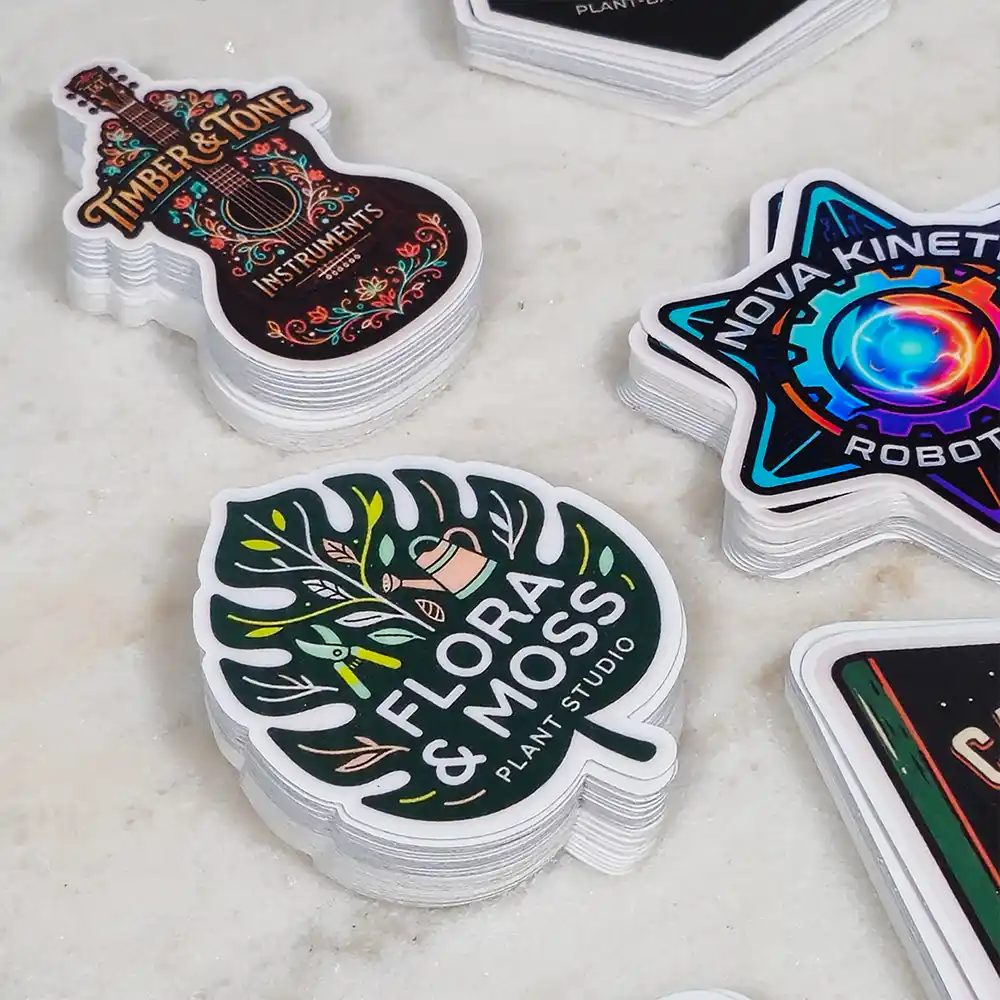
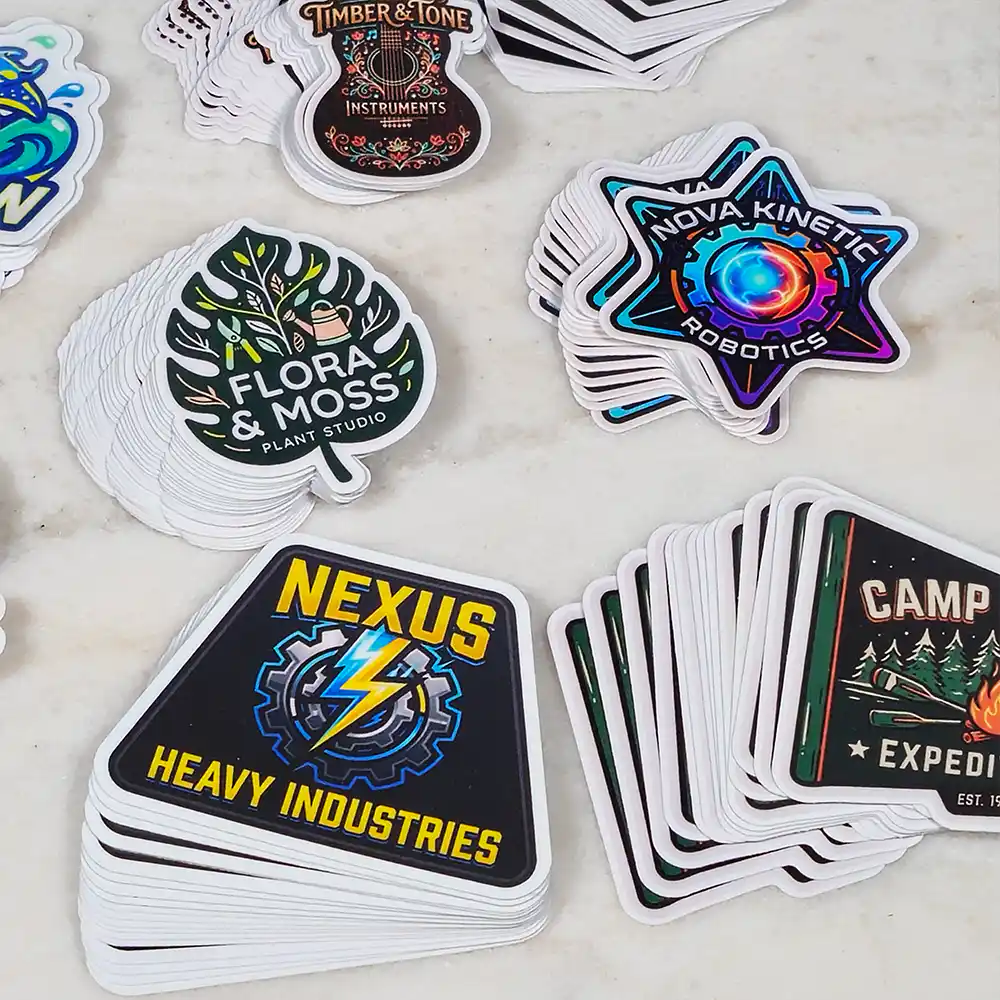
- Die-Cut: The sticker is cut to the outline of your design.
- Kiss-Cut: The sticker is cut through the top layer, leaving it on an easy-peel backing sheet.
- Vinyl colour: White or clear.
- Lamination: None, Glossy, Matte, Glossy UV, or Holographic Glitter.
Holographic Vinyl is a metallized option for a distinctive rainbow-shifting appearance. Reflective Vinyl is another material choice when you want a reflective look. Lamination provides additional ways to tailor the finish; review the available selections on the product page when configuring your order.

Match the material to the job
Use these examples as a starting point:
- Laptop or phone: Consider removable, repositionable, or permanent vinyl according to whether you want to remove, reuse, or keep the sticker in place. Check that the surface is clean and suitable.
- Mug or water bottle: Vinyl is an option for personal items. The product page describes the stickers as waterproof and fade-resistant; follow the material and finish choices shown when ordering.
- Packaging or branding: Choose a cut style that suits how customers will handle and peel the sticker. Kiss-cut stickers stay on a backing sheet; die-cut stickers follow the design outline.
- Small vehicle sticker: Consider permanent vinyl for an everyday-durable adhesive option, or high tack vinyl where a stronger grip on a curved or textured surface is needed. Surface and exposure conditions matter.
- Logo or QR code sticker: Choose a material based on where it will be applied, then size the artwork so the logo or code is easy to see and use.
The stickers are printed in full colour, and the product page describes the vinyl as waterproof and fade-resistant. Sticker production and shipping are handled 100% in-house in Canada, and Canadian shipping is free.
Promotional pricing and order sizes
The advertised prices below are a straightforward way to plan a personal project or a small promotional run:
| Quantity and size | Price |
|---|---|
| 330 stickers, 1" × 1" | $29 |
| 100 stickers, 2" × 2" | $29 |
| 100 stickers, 3" × 3" | $49 |
| 100 stickers, 4" × 4" | $69 |
| 100 stickers, 5" × 5" | $99 |
| 100 stickers, 6" × 6" | $119 |
The product page also lists custom sizes from 1" × 1" to 6" × 6", with quantities from 5 to 10,000. It notes that 50, 100, and 200 are best-value quantity points. Check the live product page for available configurations and current pricing.
A simple way to decide
Before you order, answer three questions:
- Do you want adhesive? If not, compare Static Cling and Silicone Back PET Film.
- If you want adhesive, should it come off, move, or stay? Start with Removable / Low Tack Vinyl, Repositionable Vinyl, or Permanent Vinyl accordingly.
- What is the surface like? High Tack Vinyl is listed for curved or textured surfaces. Cling and micro-suction are better considered for smooth surfaces.
Once you’ve chosen a material, select the cut style, size, quantity, and finish that fit your design. Explore the available options and place your order on the Promo Stickers Kiss/Die-Cut product page.