
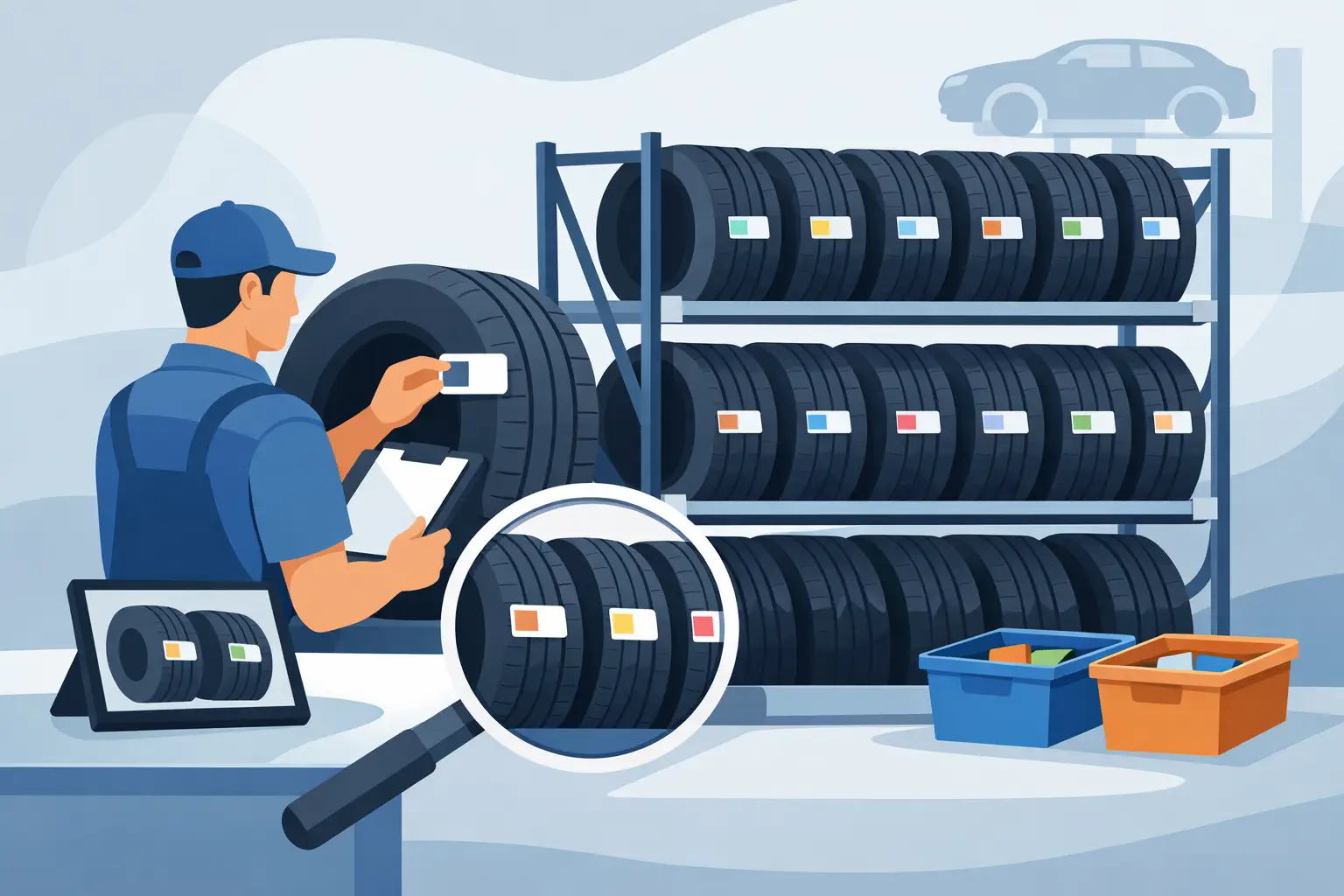
A stack of customer tires leaning against the wall all look the same after a busy week. That is where tire storage labels earn their place. For tire shops, repair facilities, and dealerships, these labels are not a small add-on. They are a practical tool that helps keep seasonal storage organized, speeds up retrieval, and cuts down on costly mistakes.
When a shop handles dozens or hundreds of stored tire sets, memory is not a system. Handwritten notes on paper tags, faded masking tape, or labels that fall off in cold storage create problems fast. The result is wasted labor, frustrated staff, and a poor customer experience when the wrong set is pulled or key vehicle details are missing.
Why tire storage labels matter in daily operations
The value of tire storage labels is simple. They help your team identify the right tires for the right vehicle at the right time. In a high-volume environment, that saves minutes on every retrieval and avoids the kind of mix-up that customers remember for the wrong reasons.
There is also a presentation factor. Clean, readable labels show that your storage process is controlled and professional. Customers may not see your storage room, but they do notice when seasonal changeovers run smoothly and their tire sets are ready when promised.
For dealerships and larger service departments, labeling also supports consistency across staff. Advisors change, technicians rotate, and storage volumes shift with the season. A clear label gives everyone the same reference point without relying on one employee’s memory or shorthand.
What good tire storage labels should include
A label only helps if the information on it is useful at a glance. In most shops, the core fields should cover the customer name, vehicle year, make and model, and a storage or reference number. Many businesses also add tire size, wheel position notes, and the date the set went into storage.
Some operations prefer a simple format with just the essentials. Others need more detailed tracking because they manage large inventories or multiple storage zones. It depends on volume and workflow. A smaller independent shop may do well with a clean label and a numbered rack system. A dealership with hundreds of stored sets may need fields for bay location, service advisor, and internal stock references.
The main point is clarity. If staff have to stop and decode handwriting or guess which field matters most, the label is not doing its job.
Readability beats complexity
It is tempting to add every possible field to a label. In practice, too much information can slow your team down. A crowded label is harder to read from a distance and easier to fill out incorrectly.
The best format usually balances enough vehicle and customer detail to avoid mistakes, while keeping the layout clean enough for fast use. Large write-in areas, clear headings, and space for bold numbers tend to work better than overbuilt designs.
Adhesive and material make a difference
Tire storage is not a front-counter environment. Labels may be exposed to dust, temperature swings, moisture, and rough handling. If the adhesive fails or the face stock smears easily, the information is gone when you need it.
That is why material quality matters. A label used in seasonal storage should stay put through handling and remain readable over time. Cheap stock can look fine on day one and fail before the next swap season. For shops that want repeatable results, durable print materials are not a luxury. They are part of operational control.
How tire storage labels improve shop efficiency
Most shops feel the pressure during spring and fall. Phones are busy, bays are full, and the storage area becomes a bottleneck if the process is not tight. Tire storage labels help reduce that pressure in a few direct ways.
First, they shorten retrieval time. Staff can find the correct set faster when every bundle or bag is clearly marked. Second, they reduce rechecking. Instead of comparing tires to work orders several times, the team can rely on visible, consistent information. Third, they support smoother handoffs between service advisors, techs, and storage staff.
Those small time savings add up. Over a full season, better labeling can free up labor, reduce interruptions, and make the day easier to manage. That matters whether you store 50 sets or 500.
Fewer mix-ups, fewer callbacks
A mislabeled or unlabeled tire set creates more than a small inconvenience. It can delay appointments, create internal confusion, and force staff to spend time fixing a problem that should never have happened. In some cases, it can even affect customer trust if they believe your shop is not handling their property carefully.
Tire storage labels reduce that risk by giving every set a clear identity. They also help when customers own multiple vehicles or when family members share similar vehicles. Names alone are not always enough. Matching the tires to detailed vehicle information helps prevent avoidable errors.
For operations that offer premium storage service, this is especially important. Customers paying for storage expect order, speed, and confidence. Labeling is part of delivering that standard consistently.
Custom vs. generic tire storage labels
There is no single right choice for every business. Generic tire storage labels are a solid option for shops that need a dependable, ready-to-use format at a competitive price. They are practical, familiar, and easy to order in volume.
Custom tire storage labels make more sense when branding, workflow, or tracking requirements are more specific. A custom format can include your logo, service department details, storage fields, color coding, or internal references that match how your team actually works.
That can improve consistency, especially in multi-advisor departments or larger shops where standardized paperwork matters. The trade-off is simple. Custom labels may take a little more setup upfront, but they can save time later by fitting your process better.
When a simple system works best
Some businesses overcomplicate storage management with too many forms, extra tags, and duplicate entries. If your team is small and your storage process is straightforward, a clean, durable label may be enough. Add a clear rack or zone system, keep naming consistent, and train staff to fill every label the same way.
Simple systems usually hold up better during peak season because they are easier to follow under pressure. The goal is not to create paperwork. The goal is to make retrieval and verification faster.
Best practices for using tire storage labels
The label itself is only part of the process. Results improve when the shop uses it consistently. That means applying labels in the same place on every stored set, writing clearly, and entering the same vehicle details every time.
It also helps to standardize when labels are filled out. Some shops do it at vehicle intake. Others complete storage labels once the tire set is bagged and checked. Either can work, but one method should be chosen and followed by everyone.
If your shop uses storage numbers or rack zones, the label should match those references exactly. A good label supports your system. It cannot fix a system that changes from employee to employee.
Seasonal planning matters
The best time to think about tire storage labels is before the seasonal rush starts. Shops that wait until the phones are ringing and storage racks are filling up usually end up patching together a process with whatever materials are on hand.
Ordering ahead gives you time to choose the right format, train staff, and avoid supply gaps during your busiest weeks. For high-volume operations, that preparation can make the difference between a smooth changeover season and a stressful one.
StickerPlanet Canada serves shops that need that kind of repeat-use print product – practical, durable, and built for real service workflows.
Choosing labels for your shop
Start with how your team actually handles stored tires. If speed is the main issue, prioritize readability and fast identification. If mix-ups are the bigger concern, include more detailed vehicle fields. If brand presentation matters, consider a custom printed label that reinforces your business every time staff handle a stored set.
Also think about storage conditions. A clean indoor tire room and a colder warehouse area do not treat materials the same way. Labels should match the environment, not just the price point.
In most cases, the best tire storage labels are the ones your staff will use correctly every day. They should be easy to write on, easy to read, and durable enough to last through storage and retrieval without peeling or fading.
A well-run shop does not leave seasonal storage to chance. The right label turns a pile of similar-looking tire sets into a controlled system your team can trust, and that kind of order pays off every busy season.