
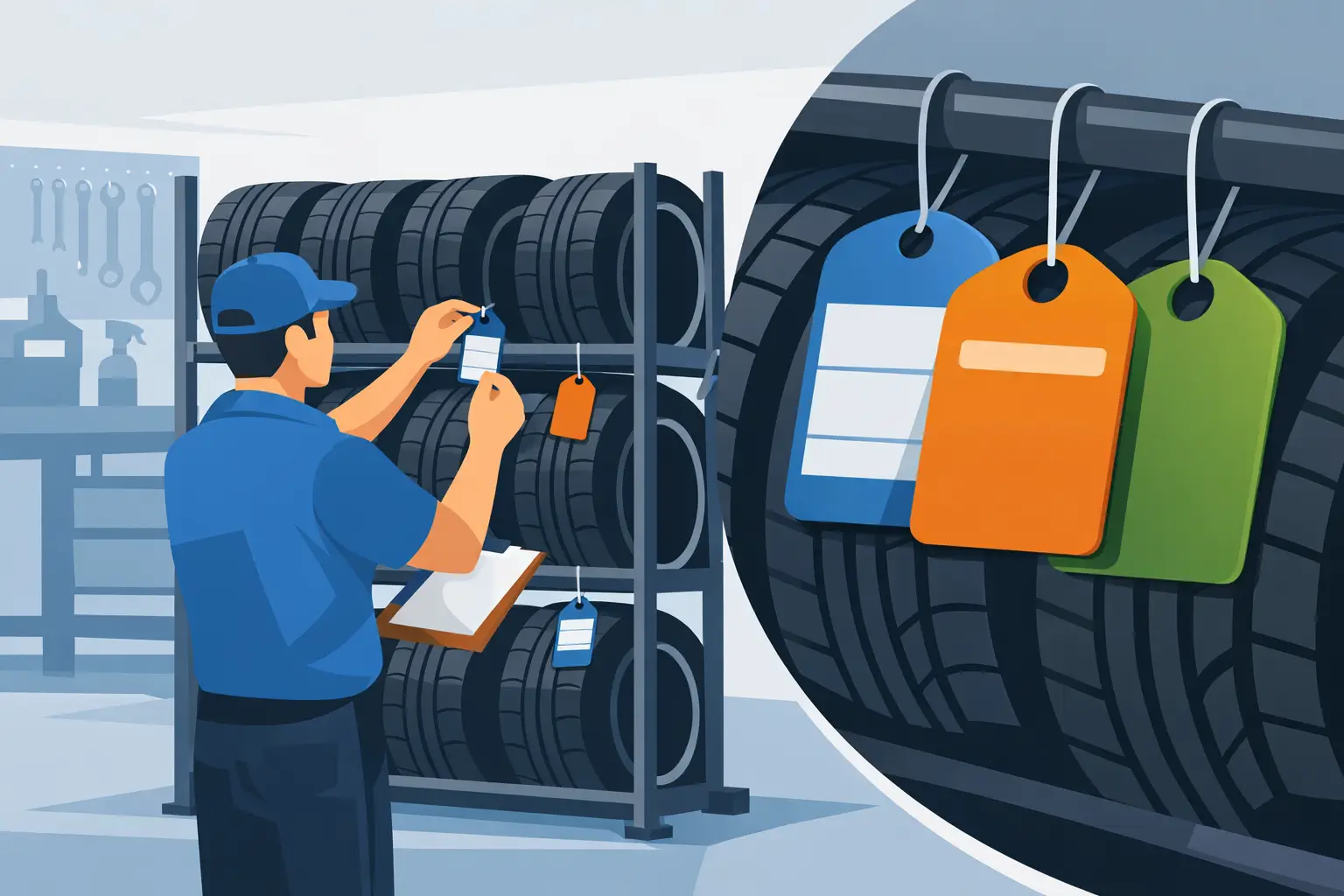
The problem usually shows up in the first cold snap or spring rush. Racks are full, the phone is ringing, and somebody is hunting for a customer’s tires with a handwritten note that made sense six months ago. If you want to organize your shop, a guide to tire storage tags starts with one simple truth: clear labeling saves time, prevents mix-ups, and makes your tire storage program easier to manage when volume spikes.
Tire storage looks straightforward until the busy season hits. Then every weak spot in your process gets exposed. Tags fall off, writing fades, customer names get misspelled, and sets that should take two minutes to find somehow take ten. That lost time adds up fast across a full day of installs, changeovers, and customer pickups.
Why tire storage tags matter more than most shops think
A tire storage tag is not just a label. It is a control point in your workflow. It ties a physical set of tires to the right customer, vehicle, season, and service record. When that information is easy to read and stays attached, your team spends less time asking questions and more time moving work through the shop.
There is also a customer service side to it. Seasonal tire storage is a convenience sale, but it only feels convenient when retrieval is fast and accurate. If a customer arrives for an appointment and your staff has to search three rack rows because two sets look similar, confidence drops quickly. Good tags help protect the value of the service you are already selling.
For dealerships and high-volume tire shops, the benefit is even bigger. A standardized tagging system creates consistency across advisors, technicians, and warehouse staff. That matters when different people check tires in, store them, and pull them months later.
Organize your shop: a guide to tire storage tags that actually works
The best tire storage tag system is the one your staff will use the same way every time. That means the tag needs enough information to be useful, but not so much that it slows down check-in. Most shops do well with a format that includes the customer name, phone number or internal reference number, vehicle year-make-model, storage date, tire position or set identifier, and a clearly visible service season.
Some operations also add license plate, repair order number, or a barcode. That can be worth it if your storage volume is high and you already use internal tracking software. If your process is mostly manual, simpler is often better. A clean, durable tag with consistent fields will outperform a complicated system that staff only fill out halfway.
Material matters too. Tire storage is not a front-counter environment. Tags get handled with dirty gloves, moved across shelving, and exposed to dust, moisture, and changing temperatures. Thin paper tags may look economical at first, but they can tear, smudge, or fall apart before the next season. Durable stock and strong attachment options reduce replacements and help keep records readable when you need them most.
What to include on a tire storage tag
A useful tag should answer the questions your team asks at retrieval time. Whose tires are these? What vehicle do they belong to? When were they stored? Where should they go next? If the tag cannot answer those quickly, it is not doing enough.
The exact fields depend on how your shop runs, but there are a few details that consistently earn their space. Customer identification is first. Vehicle information is next, especially in households with more than one car. Seasonal notation matters because the same customer may have multiple stored sets over time. A location field can also help if you use numbered racks, zones, or warehouse rows.
Color coding can make the system even faster. Some shops use one color for winter, another for summer, or separate colors by storage year. That approach works well if your volume is high and your staff is trained on the meaning. The trade-off is that color only helps if the rest of the information is still clear. It should support the label, not replace it.
The biggest mistakes shops make with tire storage tags
The most common mistake is relying on handwriting alone without a standard layout. One employee writes a full customer name, another writes only a last name, and a third uses a stock number that nobody at the front counter can match quickly. You end up with inconsistent records and avoidable delays.
Another problem is using tags that are too small or too flimsy. If the print area is cramped, staff abbreviate key details or write over other fields. If the material cannot handle storage conditions, you risk faded text or detached tags by the time the customer returns.
Some shops also miss the handoff part of the process. A good tag helps only if everyone uses it from intake through retrieval. If the service advisor records one reference number and the storage team shelves the tires under another, the tag becomes less useful. Tire storage works best when check-in, storage, and pickup all follow the same logic.
How to set up a better tire storage process
If your current system feels messy, you do not need a major overhaul to improve it. Start by choosing one tag format and using it across every stored set. Standardization is usually the fastest win. Then decide what the required fields are and train staff to complete them the same way every time.
Next, match the tag to your storage layout. If your warehouse uses aisle and rack numbers, add a clear location field. If your process is based on customer appointment dates, make sure the tag supports quick sorting or retrieval by schedule. A tag should reflect how your shop actually operates, not how an ideal system looks on paper.
Attachment method matters as well. A secure tie or reinforced hole helps the tag stay with the set through transport and storage. If the tires are bagged, think about whether the label should attach to the bag, the set, or both. There is no universal answer here. It depends on how often bags are replaced, how your staff handles sets, and whether wheel information needs to remain visible.
When custom tire storage tags make more sense than generic ones
Generic tags are fine for some shops, especially smaller operations that just need a basic, reliable solution. But once storage volume grows, custom tags usually start paying for themselves. A custom layout lets you build around your workflow instead of forcing your team to work around the tag.
That could mean adding your shop name, internal stock fields, a service reminder area, or a branded customer-facing message. It could also mean choosing a size that is easier to spot on the rack or a design that aligns with your front-counter paperwork. Those small operational details matter when you are processing hundreds of sets over a season.
Custom printing also helps create consistency across locations or departments. If multiple employees or branches are handling seasonal storage, standardized tags reduce interpretation errors. That is one reason many service operations prefer purpose-built print materials over improvised labels.
Tire storage tags and shop efficiency
Every shop wants to save labor time, but the better goal is to remove wasted motion. Tire storage tags do that by reducing searching, second-guessing, and rework. They make retrieval faster, and they also make intake cleaner because staff know exactly what information to capture from the start.
There is a sales impact too. A storage program that runs smoothly is easier to offer confidently. Advisors are more likely to recommend it when they know the back-end process is under control. Customers are also more likely to return when their experience is easy, accurate, and professional.
That is where print quality matters more than many buyers expect. Durable, clearly printed tags support repeatable service. They are not flashy, but they are one of those operational tools that quietly improve output every day. StickerPlanet Canada focuses on products like this because shops need practical materials that hold up and keep work moving.
Organize your shop with tire storage tags for the long haul
If you are reviewing your seasonal workflow, tire storage tags are one of the simplest upgrades you can make. They cost far less than the labor wasted on lost sets, delayed appointments, or preventable customer complaints. More importantly, they help create a process your team can rely on during the busiest weeks of the year.
The right setup is not about adding complexity. It is about making sure every stored set is easy to identify, easy to locate, and easy to return to the right vehicle at the right time. When your tags do that well, your storage program stops feeling like a scramble and starts working like part of a well-run shop.
A good tire storage system is not built on memory. It is built on labels your team can trust when the pace picks up.