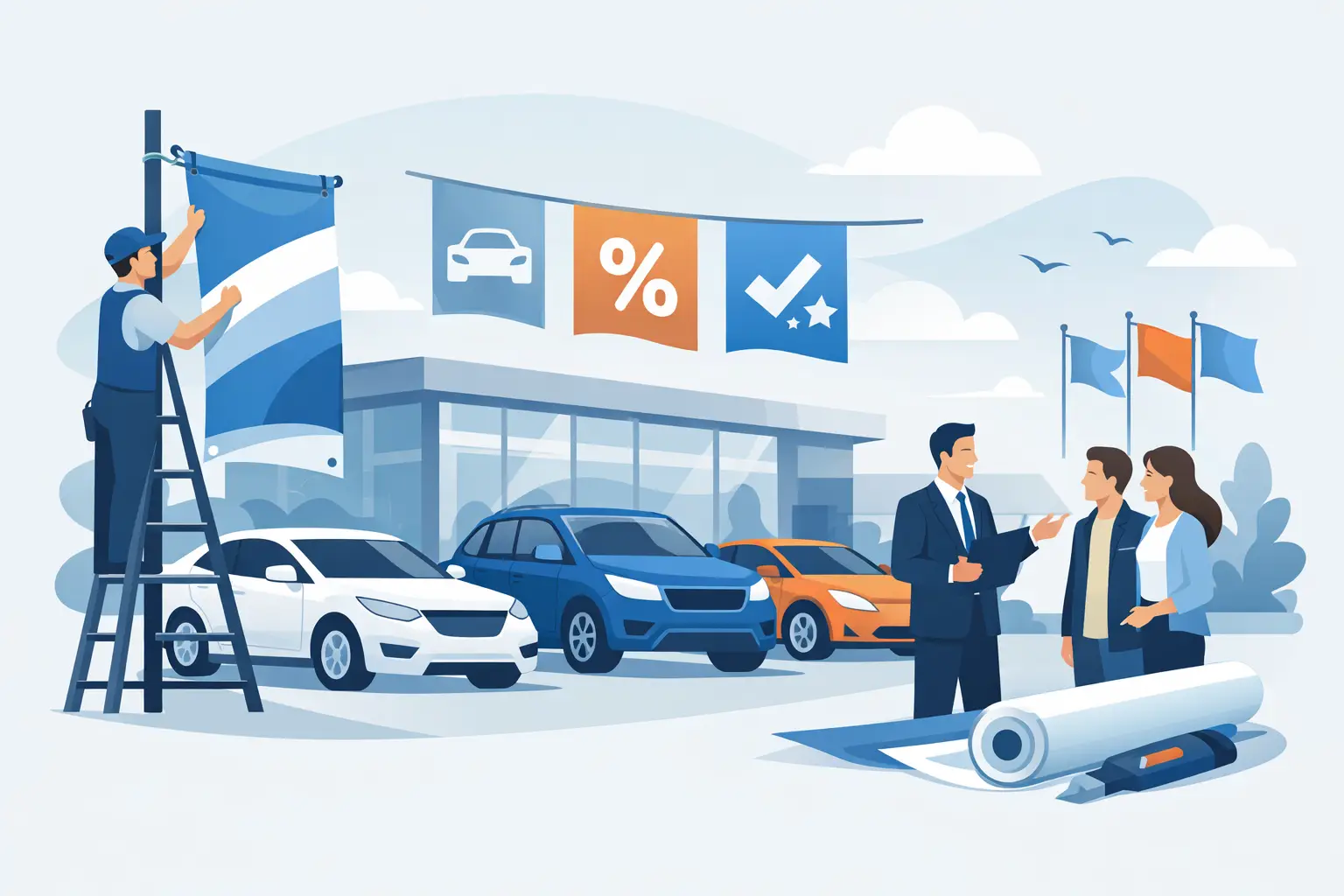
A banner that is hard to read from the service drive is wasted space. A banner that clearly directs customers to check-in, promotes a seasonal offer, or reinforces your dealership name does real work every day. This custom banners for dealerships guide explains how to choose banners that support sales, service, parts, and customer communication without adding clutter to your facility.
For dealerships, banners are not just decorative signs. They help organize traffic, answer common questions, promote time-sensitive offers, and keep your branding visible at key customer touchpoints. The best choice depends on where the banner will be used, how long it needs to last, and what action you want people to take.
Start With the Job the Banner Needs to Do
Before choosing a size or material, identify the operational purpose. A sales-event banner has different requirements than a service lane banner. One is designed to catch attention from a distance, while the other must give customers quick instructions as they enter the department.
Common dealership uses include promoting tire offers, oil change specials, detailing services, trade-in events, parts counters, customer waiting areas, and service check-in procedures. Banners can also identify designated parking areas, delivery zones, shuttle pickup points, or seasonal tire storage services.
Keep one primary message on each banner. Trying to promote three services, include every department phone number, and list several offers at once makes the sign harder to use. If the customer needs to make a decision quickly, such as where to pull in or where to park, the message should be even simpler.
A useful rule is this: if a customer cannot understand the banner in a few seconds, reduce the copy.
Custom Banners for Dealerships: Choose the Right Material
Material selection affects durability, appearance, installation, and cost. There is no single best material for every dealership application. Indoor banners can prioritize a clean presentation, while outdoor banners must handle wind, sun, rain, and changing temperatures.
Vinyl is a practical choice for many dealership banners because it is durable, easy to clean, and suitable for indoor or outdoor use. It works well for building exteriors, service drive messaging, fence displays, and event promotions. For banners that will be mounted outdoors for an extended period, reinforced edges and properly placed grommets help prevent tearing around the attachment points.
Mesh banner material is often the better option for exposed, windy locations. Its small perforations allow air to pass through, reducing stress on the banner and its mounting hardware. The trade-off is that colors and images may appear slightly less solid up close than they do on standard vinyl. At typical viewing distances, that difference is usually minor.
Fabric banners can provide a more polished look for indoor showrooms, customer lounges, trade-show displays, or presentation areas. They are less suited to harsh outdoor conditions, but they can be a strong choice when appearance matters more than weather resistance.
If a banner will only be used for a weekend sales event, a lighter-duty option may be sufficient. For permanent service department signage or repeat seasonal use, paying for durable material and finishing is usually the better value.
Make Placement Part of the Design Process
A banner is only effective if it is placed where customers can see and understand it. Measure the installation area before ordering, including the available width and height, nearby doors and windows, poles, fences, and any clearance requirements.
Consider how people move through your property. A customer driving into the service lane needs a short message in large type. A customer standing in the waiting area has more time to read details about maintenance packages or tire storage. Sales-lot traffic may see the banner from farther away, which calls for larger text and a higher-contrast layout.
Height matters as much as width. A low-hanging banner can become blocked by parked vehicles, while a sign placed too high may not be readable at all. In service areas, avoid putting essential information where it will be hidden by open overhead doors, vehicle lifts, or busy staff activity.
Also think about lighting. A dark banner with small lettering may look acceptable on a computer screen but disappear at dusk or on an overcast day. Strong contrast – such as dark lettering on a light background or light lettering on a dark background – improves readability in real conditions.
Design for Distance, Not for Your Desktop Screen
Dealership banners need to be readable at the distance where customers encounter them. That means large type, straightforward wording, and graphics that support the message instead of competing with it.
Your dealership logo should be clear and properly sized, but it does not need to dominate every square inch. For a service special, the offer and the action should come first: “Tire Storage Available,” “Service Check-In,” or “Book Your Oil Change.” Your branding confirms who is offering the service.
Use a limited color palette that matches your existing dealership materials. Consistent colors, logos, and type treatments help create a professional experience across the service drive, parts counter, waiting room, reminder stickers, and follow-up materials. That consistency helps customers recognize your dealership long after they leave the lot.
Avoid using long paragraphs, fine print, or multiple competing calls to action. If a promotion has conditions that require detailed explanation, keep the banner focused on the headline and direct customers to speak with an advisor or see the service desk. The banner should start the conversation, not carry every detail of the offer.
Images can help when they make the message faster to understand. A clean tire image may support a seasonal tire promotion. A busy collage of vehicles, tools, logos, and product shots usually does the opposite. When in doubt, prioritize clear text over extra artwork.
Select a Size That Fits the Viewing Distance
Banner dimensions should match the space and the audience. A smaller banner may work well at a parts counter or beside a service advisor desk, where customers are only a few feet away. A larger horizontal banner is usually more effective over a service entrance, along a fence, or across a showroom wall.
For vehicle traffic, bigger is generally better, provided the message stays simple. Large lettering creates impact from a distance and gives drivers time to process the information. A banner that looks oversized in a design proof can look appropriately sized once it is mounted outside.
Vertical banners are useful when wall space is narrow or when you need to identify an entrance, department, or event area. Horizontal banners are often better for broad building facades and fence lines. The right format comes down to the available space and sightline, not just personal preference.
Plan for Installation and Reuse
A well-printed banner still needs secure installation. Choose finishing options based on how and where it will be mounted. Grommets are a common option for attaching banners to walls, fences, poles, or frames. Reinforced hems add strength for larger banners and outdoor applications.
Use hardware appropriate for the surface and expected weather conditions. Avoid pulling a banner overly tight, especially outdoors. A small amount of controlled movement can be better than placing constant stress on the material and grommets. Check the banner periodically, particularly after heavy wind or storms.
If you plan to reuse seasonal banners, store them clean and dry. Roll them rather than folding them whenever possible, since folds can leave visible creases. Label stored banners by campaign or season so staff can find the correct sign without sorting through a pile of old materials.
For promotions that repeat each year, leave variable dates off the main banner when possible. A message such as “Seasonal Tire Changeover” can be used again, while a banner printed with specific dates becomes outdated quickly. This approach reduces replacement costs while keeping your facility ready for the next campaign.
Order With Daily Dealership Operations in Mind
The ordering process should support your schedule, not slow it down. Gather your logo files, approved brand colors, final wording, banner size, and installation details before submitting artwork. This avoids last-minute changes that can delay production.
Review proofs carefully. Check phone numbers, offer dates, spelling, department names, and logo placement. It is much easier to correct a proof than to replace a finished banner. If several departments will use banners, establish a simple approval process so sales, service, and management are working from the same information.
StickerPlanet Canada produces practical printed materials for automotive businesses that need consistent, professional communication. Pairing dealership banners with service reminder stickers, tire labels, and maintenance messaging can help carry the same brand experience from the service drive to the customer’s windshield.
The right banner should make one part of your dealership easier to navigate, easier to promote, or easier to remember. Start with the customer action you need, build the design around that action, and choose materials that can handle the job.